
The blockchain trilemma of achieving scalability, security, and decentralization remains the central challenge for Layer 1 platforms. This research article provides a comparative technical analysis of two high-performance blockchains, Pharos and Monad, which propose divergent paths to scalability. While Monad employs a heavily optimized synchronous model based on pipelined execution and a modified PBFT consensus, Pharos introduces a foundational shift with a fully asynchronous, leaderless consensus (Pharos Consensus) and a deterministic, parallel execution engine (DTVM). By decoupling execution from consensus, introducing a revolutionary state storage model, and embracing a multi-virtual machine future, Pharos achieves not only higher performance ceilings but also greater flexibility, security, and developer freedom than Monad’s monolithic design. Our analysis concludes that Pharos's architectural paradigm—prioritizing asynchronous robustness, leaderless fairness, and modular generality—offers a more sustainable and fundamentally scalable foundation for the global, adversarial environments of future decentralized networks.
The evolution of Layer 1 blockchains is marked by a transition from monolithic designs to modular, performance-oriented architectures. Platforms like Solana push the limits of synchronous assumptions, while others like Aptos and Sui explore parallel execution. In this landscape, Monad and Pharos represent two distinct philosophical approaches.
This research article will demonstrate that while Monad's optimizations yield significant performance gains within its model, Pharos's architectural choices provide superior resilience, fairness, and long-term scalability.
The consensus mechanism dictates the security, finality, and resilience of a blockchain under network stress.

MonadBFT is a sophisticated variant of HotStuff/PBFT that pipelines block proposal, validation, and commitment to improve throughput. However, it remains leader-based and partially synchronous. This creates inherent bottlenecks and centralization risks, as the leader controls transaction ordering and can become a performance limiter. Its performance is optimal only under good network conditions.
In contrast, Pharos Consensus is architected for a fully asynchronous network, the most robust and adversarial model. Its leaderless, concurrent proposal mechanism eliminates the single-leader bottleneck, enabling linear scalability with the number of validators. The adaptive fast path (3-round commit under agreement) provides low-latency finality comparable to synchronous protocols in the happy case, while its asynchronous fallback guarantees liveness even under severe network partitions. This makes Pharos resilient to real-world WAN volatility and targeted attacks on leaders, a vulnerability in Monad's model.
Conclusion: Pharos provides a fundamentally stronger security and resilience guarantee than Monad, operating correctly under strictly weaker (and more realistic) network assumptions.
Achieving high throughput requires efficient transaction processing, primarily through parallel execution.

Monad's execution engine is a highly optimized parallel EVM. It uses an optimistic approach, executing transactions in parallel and re-executing in case of conflicts. This is a proven model. Its deep pipelining of execution, state commitment, and consensus is a key performance driver.
Pharos's execution engine, however, introduces several foundational advancements:
Conclusion: While Monad excels at parallelizing the existing EVM, Pharos's DTVM and SALI represent a next-generation execution environment that offers greater determinism, lower latency, and broader language support.
The storage layer is often the ultimate limiter of throughput and node operability.
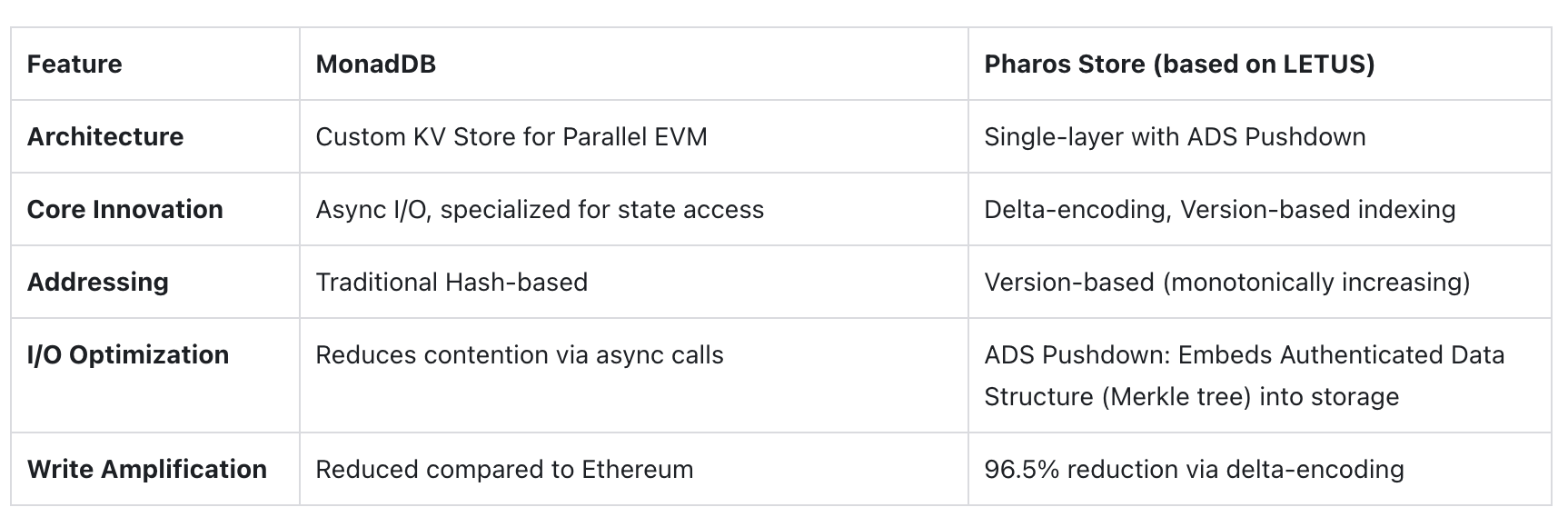
MonadDB is designed to handle the random read/write patterns of a parallel EVM by leveraging asynchronous I/O operations, preventing disk I/O from stalling execution threads. This is a significant improvement over Ethereum's LevelDB.
Pharos Store, architected on the LETUS principles, is a revolutionary leap. Its key innovation is ADS Pushdown, which integrates the Merkle tree directly into the storage engine. This collapses the traditional two-layer architecture (Merkle Tree + KV Store) into one, slashing the I/O path for an account access from 8-10 disk reads in Ethereum to just 1-3. Furthermore, by using version-based indexing instead of hash-based addressing, it eliminates the compaction overhead of LSM-trees, reducing disk bandwidth consumption by 96.5%. The use of delta-encoding ensures that only state changes are written, cutting storage overhead by over 80%.
The result is a 15.8x improvement in I/O throughput and a 90% reduction in latency compared to Ethereum's storage model. This architectural advantage allows Pharos to scale to billions of accounts without degradation, a more profound solution than optimizing access to an existing storage paradigm.
Conclusion: Pharos Store's single-layer, versioned, and delta-encoded architecture addresses the root causes of storage inefficiency, offering a performance and scalability advantage that is architectural, not just incremental.
This is the most significant differentiator. Monad’s vision ends with a single, powerful chain. Pharos’s begins there.
Monad, the monolithic endpoint, is the culmination of the "one chain to rule them all" philosophy. It is designed to be the highest-performance EVM chain. Any further scaling or specialization is outside its core design, potentially requiring complex and less secure bridging to external ecosystems.
Pharos, the modular launchpad, is designed as a modular hub from the outset via its Special Processing Networks (SPNs).Here is what SPNs has to offer, which takes Pharos leaps ahead in comparison to its current competitors:
Conclusion: Monad's architecture is monolithic. It offers high throughput for EVM-compatible transactions but lacks a native framework for creating specialized runtime environments. Pharos's SPN model provides unparalleled flexibility, allowing the network to evolve and specialize without hard forks. It enables use cases that are simply outside the design scope of Monad, making Pharos a platform for a broader and more innovative class of decentralized applications.
This is where Pharos establishes a paradigm that Monad's documentation does not address. Pharos provides a full-stack environment that automates development and enables specialized computation, moving beyond raw performance to holistic usability.
Pharos integrates DTVM SmartCogent, an AI-powered multi-agent framework that automates the entire smart contract lifecycle. This is a monumental leap in developer experience and security.
Conclusion: Monad's documentation focuses on core protocol performance. It does not articulate a comparable, integrated AI-driven development suite. This positions Pharos not just as a runtime environment, but as an intelligent platform that actively reduces developer overhead and elevates code security to an institutional grade, which is a critical factor for enterprise and DeFi adoption.
Our comparative analysis reveals that while Monad is a masterclass in optimizing the existing synchronous paradigm, Pharos is architected for the next generation of decentralized infrastructure.

Pharos enables specialized, high-performance execution environments natively.
Monad brings unprecedented performance to the EVM ecosystem, a vital contribution. However, Pharos presents a superior long-term architectural vision. By building on a fully asynchronous, leaderless consensus and a deterministic, high-performance execution environment, Pharos is not merely faster but is fundamentally more robust, fair, and versatile. Pharos is engineered to be the scalable, secure, and versatile foundation for a globally distributed web. It addresses the full stack of challenges facing Web3, making it the more advanced and future-proof platform of the two.


